
Fayette Projected Versus Actual Release
A projected or tentative date is a calculation about a future institutional exit. An actual release is a recorded event. The difference matters in Fayette County because a court order, sentence credit, discipline, another sentence, or an outside hold may change what happens before the expected day. A displayed date should be recorded with the date it was viewed and checked again near the event.
A pretrial detainee has no sentence-based release calculation. The Fayette court may order release or detention, but the sheriff record shows when physical processing ended and whether another authority received the person. A sentenced person has a judgment that supplies the legal term. Even then, the county jail and IDOC apply different credit laws and record systems.
- Projected date
- A revisable estimate calculated from the sentence and applicable credit.
- Actual release
- The recorded institutional or jail exit event.
- Detainer
- A request or legal basis for another authority to take or keep custody.
- MSR
- Mandatory supervised release after an IDOC term, not final discharge.
Find a Fayette Release Date
Begin with custody history, not with a universal calculator. A Fayette County jail episode, an IDOC sentence, and federal imprisonment use separate rules. The IDOC Individual in Custody Search covers current and former state prisoners. It does not calculate a Fayette-only county jail term.
- Identify the facility and sentence. Check the Fayette court judgment for a county term, probation, pretrial status, or commitment to IDOC.
- For an IDOC term, search by IDOC number when available, or use last name and birth date. Compare identity, status, location, admission, sentencing, and release history.
- Transcribe the live interface's exact projected or tentative date label. Do not manufacture a date when no field appears.
- For a county sentence, ask the Fayette County Sheriff's Office for the custody and movement record and read it with the judgment.
- Recheck near the projected day. Confirm the actual event through the responsible agency and determine whether the exit was community release, MSR, or transfer.
The full Fayette released-inmate lookup explains how to reconcile the sheriff record with the court order. If the person moved from county custody to IDOC, the county departure was a transfer, not the projected end of state imprisonment.
Fayette IDOC Release Fields
IDOC permits a search by last name, IDOC number, or birth date. A matching detail may show the person's name, IDOC number, vital statistics, status or location, admission and release dates, sentencing information, an institutional image, and a live projected or tentative date. The exact dynamic label must be read from the current result.
| Field | How it helps | Limit |
|---|---|---|
| IDOC number | Strong match key across state records | Does not identify a county booking alone |
| Status or location | Shows current state-system position | May change after transfer or release |
| Admission and release history | Places the projected date in sequence | A past release may precede a later return |
| Projected or tentative date | Reports the live Records Office calculation | Not proof that release occurred |
| Sentencing information | Connects the record to the state term | Read with the actual judgment |
The official IDOC direct offender search is shown below.
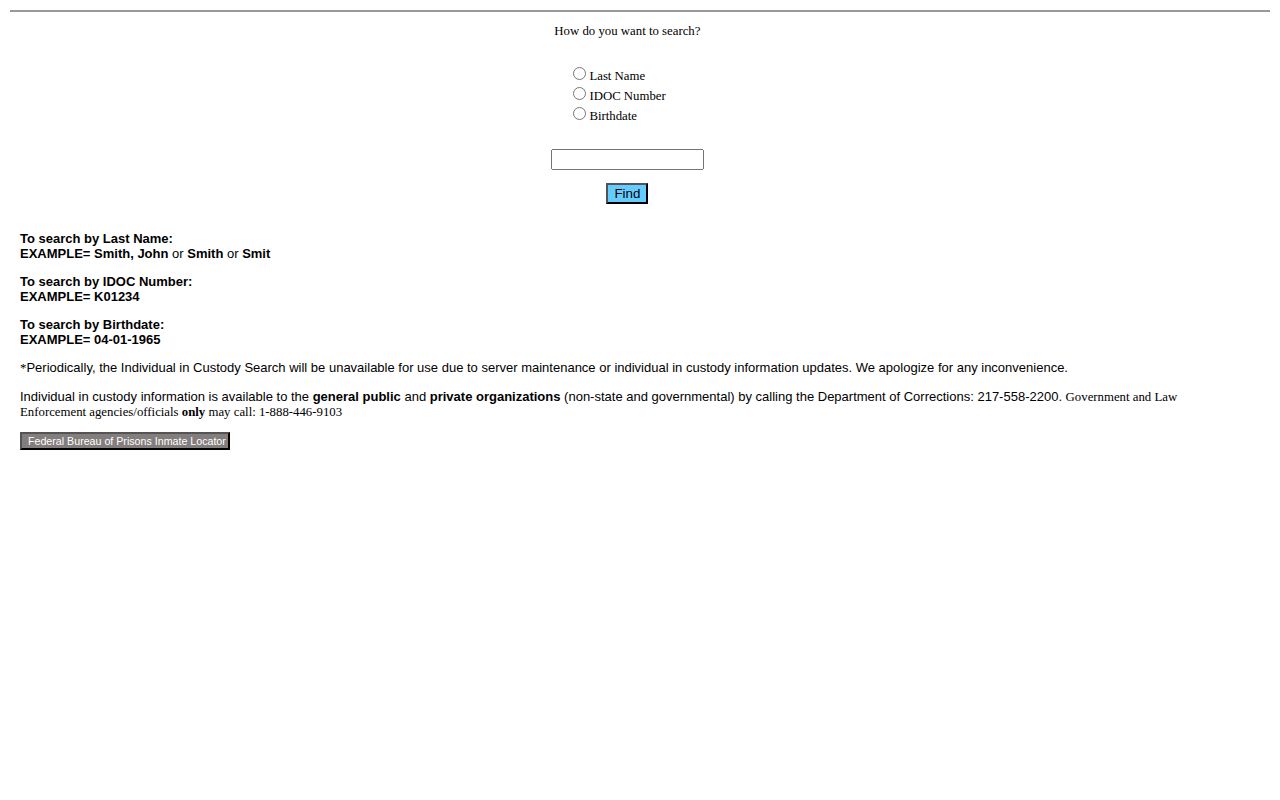
The form supplies the state lookup entry point without exposing an unrelated person's record.
Illinois Fayette Sentence Credit
The core state statute is 730 ILCS 5/3-6-3. It contains ordinary credit, earned or program credit, exclusions, caps, and truth-in-sentencing floors. The controlling rule depends on the offense, sentence, and applicable date. It cannot be reduced to a claim that every person serves half.
Specified sentences can require service of 85 percent, 75 percent, or 100 percent. A charge label alone is not enough to assign a tier. Read the sentencing judgment and controlling statutory subsection, then use the date IDOC actually calculates. Earned Discretionary Sentence Credit can affect the result, but an outside observer should not predict an award.
The statute source below provides the official basis for the calculation.
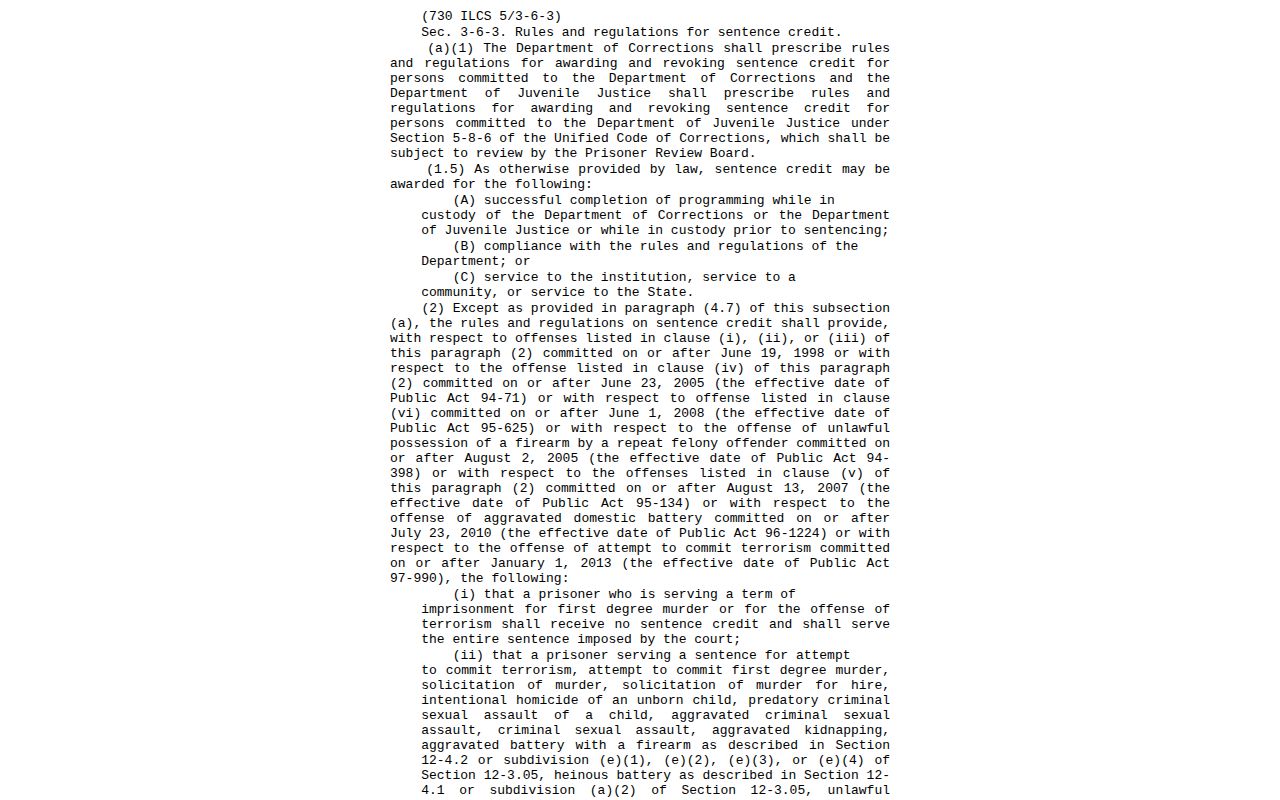
Its many offense-specific provisions are why a simple date formula is unreliable.
Note: IDOC publishes DOC.EDSCInquiries@Illinois.gov for Earned Discretionary Sentence Credit questions tied to an official state calculation.
Why Fayette Dates Resist Shortcuts
Illinois projected dates are easy to oversimplify because sentence credits coexist with the three truth-in-sentencing floors. For a determinate sentence, the Prisoner Review Board explains that IDOC's Records Office calculates the institutional release date. PRB generally does not choose that date through an individualized parole vote.
The PRB mandatory supervised release explanation also separates prison exit from final discharge. A person can reach the IDOC-calculated date and enter MSR while remaining under correctional supervision. This is why “release date” must be paired with status.
The official MSR source is pictured below.
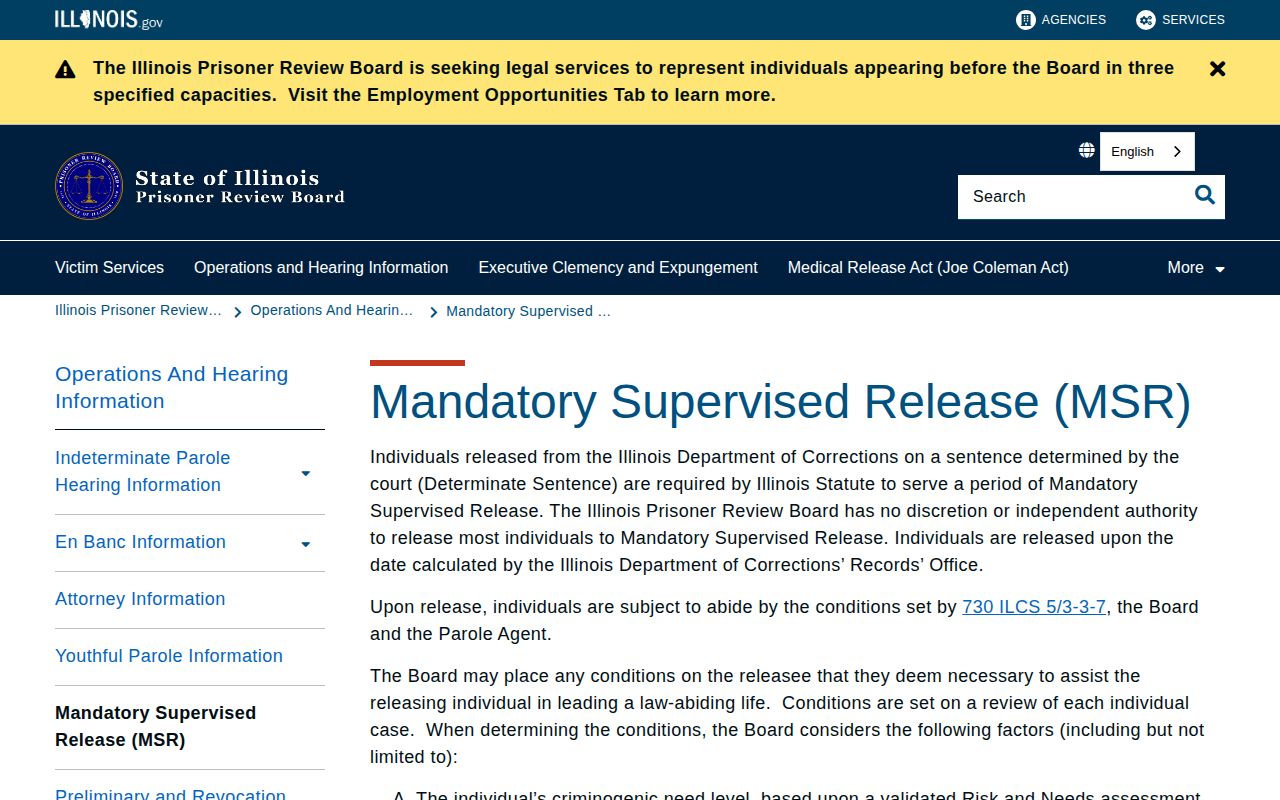
It supports the state process but does not calculate a Fayette county-jail sentence.
Changes to Fayette Release Dates
A projected date can move earlier or later only through rules and records that apply to the sentence. The table separates common causes without predicting their effect on a particular person.
| Factor | Possible effect | Record to check |
|---|---|---|
| Corrected jail credit | Changes credited time | Judgment, mittimus, and IDOC calculation |
| Sentence credit | May reduce time under governing law | IDOC Records Office history |
| Disciplinary loss or restoration | Can move the projected date | IDOC disciplinary and credit record |
| Additional sentence or court order | Can alter the aggregate term | Filed judgment and sentence data |
| Revocation | May return a person to custody for recalculation | PRB revocation decision and IDOC record |
| Detainer or transfer | Can prevent community release | Movement record and receiving-agency record |
None of these rows proves a change by itself. For a disputed state calculation, route the question to IDOC Records or Constituent Services with the IDOC number, judgment, and the date seen online.
Fayette County Jail Calculations
A county sentence is separate from IDOC arithmetic. Illinois county terms are governed in part by the County Jail Good Behavior Allowance Act, 730 ILCS 130. Use the Fayette sentencing order and the Sheriff's Office custody record. Do not apply an IDOC truth-in-sentencing percentage or institutional credit estimate to a county-only term.
The sheriff site does not publish a projected-release calculator, release hour, or recent-release feed. Ask for the booking and custody movement or release record for the named episode. Useful fields include admission, case number, recorded release date and time, release reason, and transfer destination if maintained and releasable. A court judgment may explain the legal term while the jail record documents what occurred.
Weekends, holidays, processing steps, and outside holds should not be guessed. If the judgment appears to set an end date, confirm the physical exit with the Sheriff's Office. Another county, IDOC, USMS, or ICE may take custody immediately.
Federal Dates Near Fayette County
A federal sentenced person belongs in the BOP Inmate Locator, not IDOC. BOP can show a release date and a status such as Released or Not in BOP Custody. A future federal date is also a projection and does not prove freedom from another jurisdiction or supervision.
The BOP lookup source is shown below.
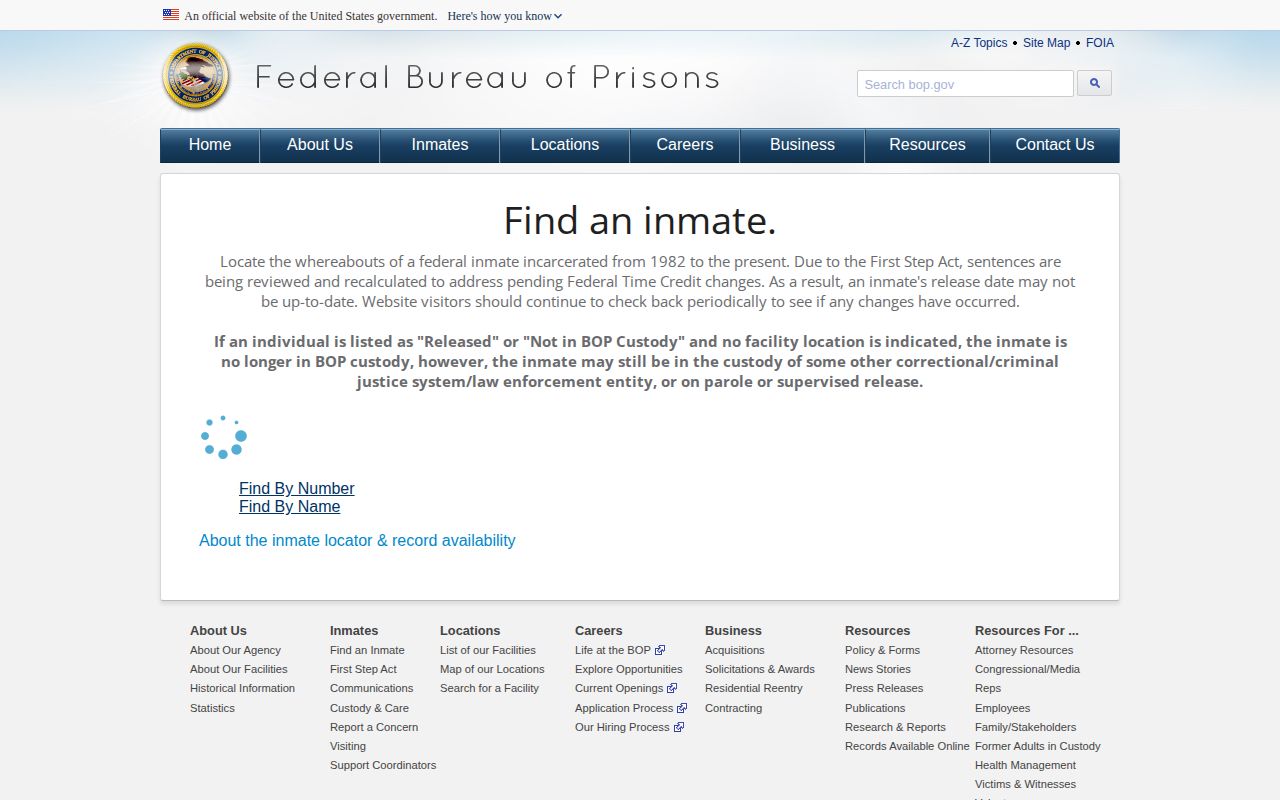
Its identifiers and date fields apply to federal BOP custody, not the Fayette jail or Vandalia Correctional Center.
Confirm Fayette Actual Release
Near the expected date, recheck the source that owns the sentence. For IDOC, compare current status, location, and admission or release history. For a county term, obtain the sheriff movement record and compare the court file. For BOP, read the federal status while checking for another jurisdiction.
A VINELink inmate search can add a timely alert for participating Illinois records. It is not a date calculator and does not certify final discharge. Read the event type and reporting facility, then confirm a release or transfer with that agency.
The final wording should remain narrow: released from Fayette County custody, transferred to IDOC, released from an IDOC institution to MSR, or finally discharged. Each phrase answers a different question.
Review Fayette Release Calculations
When the displayed date conflicts with a judgment or an earlier record, preserve the exact IDOC label, the value shown, and the date of access. Then compare the sentencing judgment, credited county-jail time, admission history, and any later sentence or revocation. A screenshot can document what the public interface showed, but it does not override the Records Office calculation.
Questions about Earned Discretionary Sentence Credit go to the published EDSC inquiry address. Other state calculation questions should be routed through IDOC Constituent Services with the IDOC number and enough case detail to identify the sentence. PRB handles its own release-condition, revocation, and discharge records; it is not the office that corrects a routine determinate date.
For a Fayette-only jail sentence, keep the same discipline but change the sources. Compare the signed county judgment with the Sheriff's custody record and ask the record owner to resolve any recorded discrepancy. Do not import an IDOC percentage, a federal credit rule, or an online calculator into that county calculation. Each system must account for its own sentence and custody time.