
Fayette County Supervision Types
A useful check starts with three distinct statuses. Probation is a court sentence served in the community under the Fayette County Probation Office. Parole or mandatory supervised release, often shortened to MSR, follows an Illinois Department of Corrections prison term and is supervised through IDOC. Final discharge means the correctional commitment has ended through the proper order and court entry. Leaving the jail or prison proves none of these by itself.
The court docket may show probation, its term, later modification, revocation, or termination. An IDOC record can show that physical prison custody ended and that MSR or parole began. Under 730 ILCS 5/3-3-8, a Prisoner Review Board final-discharge order takes effect when entered, and the committing clerk records satisfaction. That order and entry are stronger final-discharge proof than a release date alone.
| Status | Who imposes or records it | Best verification source |
|---|---|---|
| Probation | Fayette County circuit court | Court judgment and Fayette Probation |
| Parole or MSR | IDOC and Illinois Prisoner Review Board | IDOC status/history and Parole Division |
| Final discharge | Prisoner Review Board and committing court | Discharge order and court satisfaction entry |
- Probation
- A community sentence ordered by a court, sometimes instead of incarceration.
- MSR
- Mandatory supervised release after an IDOC term, with rules enforced in the community.
- Discharge
- The legal end of the sentence or correctional commitment, not merely release from a building.
- Absconder
- A person alleged to have stopped reporting or left supervision without permission.
Check Fayette County Parole Records
No single public Fayette County name search proves every form of supervision. The IDOC Individual in Custody Search is the right starting point for a current or former state prisoner. The Fayette Judici search and the circuit court file are the right starting points for a local probation sentence. Match identifiers carefully because name-only matches can point to the wrong person.
- Identify whether the person left the Fayette County jail or an IDOC institution. A transfer from the jail to IDOC was not community release.
- For a state sentence, search IDOC by IDOC number when available, or use last name and birth date. Read status, location, admission, and release history together.
- For probation, locate the Fayette case by name or case number. Read the judgment, probation order, modifications, and termination entries.
- Contact the responsible office to confirm current supervision. Ask IDOC Parole about state supervision and Fayette Probation about a local or accepted transfer case.
- For final discharge, seek the Prisoner Review Board order and the committing court's satisfaction entry instead of relying on a past release date.
An online record can lag or omit a document. The Fayette County Circuit Clerk retains court files and a public computer in Room 112 when an online summary is unclear. The broader Fayette County released-inmate search explains how a sheriff movement record and court order work together when the custody path is uncertain.
Note: A person absent from the IDOC search may have served only a county sentence and may still have a Fayette court record.
Fayette County Probation Office
The Fayette County Probation Office supervises probation imposed in Fayette County. Its published work also includes cases transferred from other Illinois counties or other states when the person lives in Fayette County. That residence-based role matters: local reporting does not prove the conviction occurred in Fayette County.
Courthouse, Room 111
221 S. 7th Street
Vandalia, IL 62471
Phone: 618-283-5009
Monday through Friday, 8 a.m. to 4 p.m.
The office can address administration of a probation case, but it does not replace the court record. A caller should have the person's full name and case number when possible. Questions about whether a judge imposed, changed, revoked, or ended probation belong with the court file. Questions about day-to-day reporting belong with probation staff.
The page image below comes from the official Fayette Probation Office source.
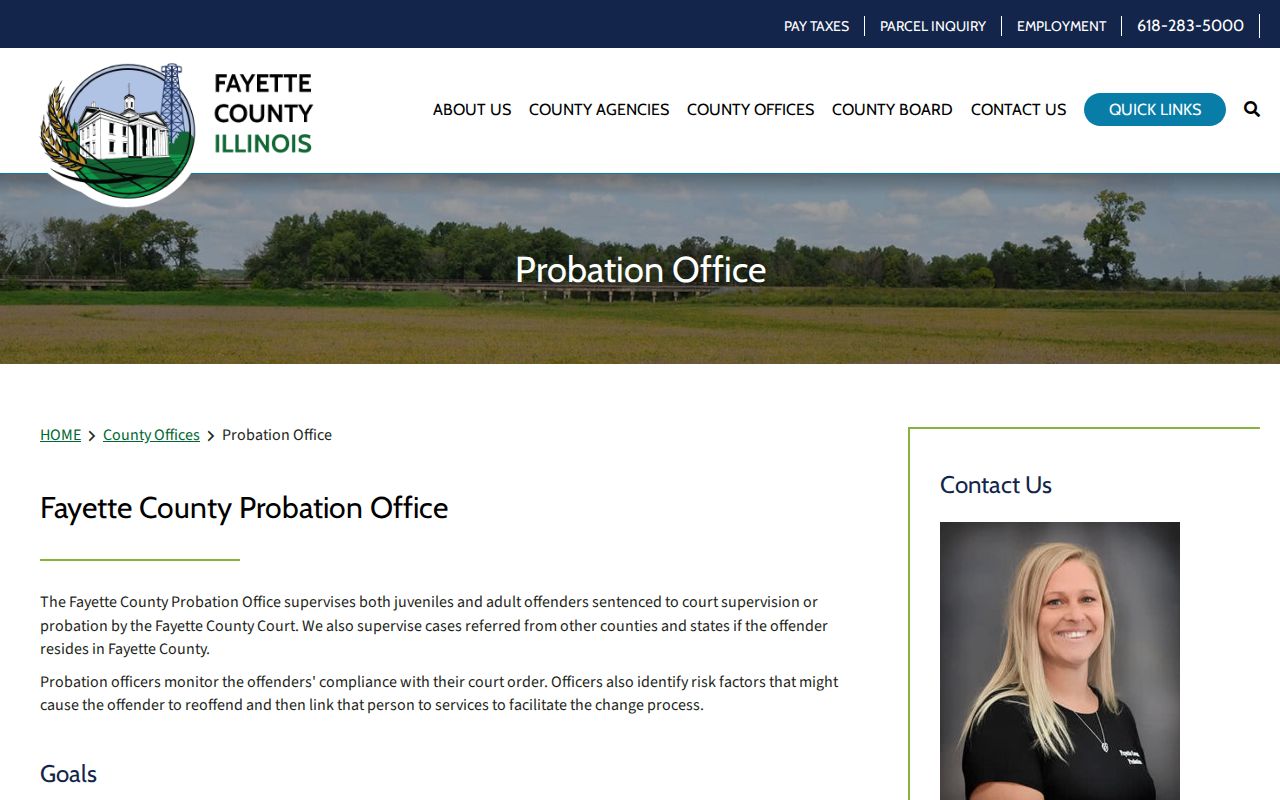
It provides the local office identity and published supervision programs, not a public list of people on probation.
Fayette County Probation Programs
Fayette publishes unusually specific program information. The local office describes public service work, Men Challenging Violence, drug testing, GPS monitoring, Moral Reconation Therapy, administrative sanctions, and Drug Court. These services and controls show how broad community supervision can be. They are not a released-person roster and should not be treated as proof that a named person participates.
A court order controls the actual terms in one case. Conditions may address reporting, residence, travel, treatment, testing, conduct, or other lawful requirements. Program availability does not establish the conditions imposed on anyone. To confirm a term, read the signed probation order or later modification and then ask the supervising office how the order is administered.
Probation may follow jail time, may be imposed without a county jail sentence, or may arise after a case disposition that never involved IDOC. By contrast, MSR follows an Illinois prison term. Keeping those paths separate prevents a local probation program from being mistaken for state parole.
Illinois Parole After Fayette Release
The Illinois Prisoner Review Board explains mandatory supervised release, while the IDOC Parole Division supervises people in the community. For most modern determinate sentences, the IDOC Records Office calculates the institutional release date. The board does not hold a discretionary parole-grant vote for every such release.
PRB sets or administers release conditions within its authority and handles revocation and final-discharge functions. IDOC Parole addresses community supervision. The distinction becomes important when a past IDOC release date appears online: that date may mark release from the institution to MSR, not the end of state control. A later discharge order is a separate record.
Parolee Assistance and office information
Use the official IDOC contact route to identify the assigned district office.
For records, IDOC FOIA can be reached at DOC.FOIARequest@doc.illinois.gov. PRB records requests for parole, revocation, or final discharge go to prb.foia@illinois.gov. Those two mailboxes serve different agencies and record sets.
Note: Parole and MSR mean release from an institution under supervision; neither term alone proves final discharge from the sentence.
Fayette Supervision Violations
An absconder or warrant concern is an enforcement question, not proof that the person was never released. A person can leave jail or prison, begin probation or MSR, and later face an alleged breach. The underlying release remains part of the custody history even when an arrest warrant or revocation process follows.
No public Fayette County probation absconder database was confirmed in the official research sweep. Do not substitute an unofficial list. For local probation, check the Fayette court docket for a petition, warrant entry, revocation order, or new disposition and confirm the current case status with the clerk or probation office. For MSR or parole, use IDOC and the Prisoner Review Board process.
Under 730 ILCS 5/3-3-7, state release conditions can govern conduct and reporting. Revocation may lead to renewed IDOC custody and a recalculated date. A VINE alert can give notice of a custody change, but it does not decide whether a violation occurred.
Confirm Fayette County Discharge
Probation ends through the court record. Look for a termination, discharge, satisfaction, revocation, or other final order rather than estimating from the original term. A modification, tolling issue, or later proceeding can change the apparent end date. The clerk supplies the filed record; probation staff can confirm the office's supervision status but cannot rewrite the judgment.
State supervision ends through the applicable IDOC and PRB record. A past institutional release date confirms only one event. For final discharge, request the PRB order and compare the committing court's entry. If another sentence, hold, or jurisdiction exists, the end of one supervision term does not answer the other agency's status.
This last check protects against the most common error in Fayette County parole and probation research: treating release, community supervision, and discharge as synonyms. They are three points in a custody and sentence history, and each has its own record owner.